

What Is The Basic Molecular Makeup Of A Hydroxyl Group
1.nine: Functional Groups
- Page ID
- 8229
Functional Groups
A functional group is a specific group of atoms inside a molecule that is responsible for a characteristic of that molecule. Many biologically agile molecules contain one or more functional groups. In Bis2a we volition hash out the major functional groups establish in biological molecules. These include: Hydroxyl, Methyl, Carboxyl, Carbonyl, Amino and Phosphate.

The functional groups shown here are found in many different biological molecules. "R" represents any other atom or extension of the molecule. The charges discussed, but non depicted, here at pH 7 . Attribution: Marc T. Facciotti (own piece of work adapted from previous image of unknown source)
A functional group may participate in a variety of chemical reactions. Some of the important functional groups in biological molecules are shown above; they include: hydroxyl, methyl, carbonyl, carboxyl, amino, phosphate, and sulfhydryl (R-South-H). These groups play an important role in the formation of molecules similar Dna, proteins, carbohydrates, and lipids. Functional groups can sometimes be classified equally having polar or non-polar backdrop depending on their atomic limerick and organisation. The term polar describes something that has a property that is non symmetric about it - it tin can have different poles (more than or less of something at dissimilar places). In the case of bonds and molecules, the holding nosotros care almost is usually the distribution of electrons and therefore electric charge between the atoms. In nonpolar bonds or molecules electrons and charge will be relatively evenly distributed. In a polar bond or molecule, electrons volition tend to be more concentrated in some areas than others. An example of a nonpolar group is the methyl grouping (see discussion in Atoms to Bonds for more than particular). Among the polar functional groups is the carboxyl group plant in amino acids, some amino acid side chains, and the fatty acids that course triglycerides and phospholipids.
Non-Polar Functional Groups
Methyl R-CH3
The methyl grouping is the only non-polar functional group in our class listing above. The methyl grouping consists of a carbon atom bound to three hydrogen atoms. In this class we will treat these C-H bonds equally effectively nonpolar covalent bonds. This ways that methyl groups are unable to form hydrogen bonds and will not interact with polar compounds such as water.

The methyl groups highlighted above are plant in a variety of biologically relevant compounds. In some cases, the compound tin can have a methyl grouping merely still be a polar compound overall due to the presence of other functional groups with polar backdrop (run into Polar Functional Groups discussed below).
Equally we acquire more than almost other functional groups, we volition add to the list of not-polar functional groups. Stay alarm!
Polar Functional Groups
Hydroxyl R-OH
A hydroxyl (alcohol group) is an –OH group covalently bonded to a carbon atom. The oxygen atom is much more electronegative than either the hydrogen or the carbon, which volition cause the electrons in the covalent bonds to spend more time around the oxygen than effectually the C or H. Therefore, the O-H and O-C bonds in the hydroxyl group will be polar covalent bonds. The figure below depict the fractional charges δ+ and δ- associated with hydroxyl group.


The hydroxyl functional groups can course hydrogen bonds, shown as a dotted line. The hydrogen bail will course betwixt the δ- of the oxygen atom and a δ+ of the hydrogen atom. Dipoles shown in bluish arrows. Attribution: Marc T. Facciotti (original work)
Hydroxyl groups are very common in biological molecules. Hydroxyl groups announced on carbohydrates (A), on the R-groups of some amino acids (B), and on nucleic acids (C). Can you notice any hydroxyl groups in the phospholipid in (D)?

Hydroxyl groups announced on carbohydrates (A glucose), on some amino acids (B Serine), and on nucleotides (C Adenosine triphosphate). D is a phospholipid.
Carboxyl R-COOH
Carboxylic acid is a combination of a carbonyl group and a hydroxyl group attached to the same carbon, resulting in new characteristics. The carboxyl group tin can ionize, which means it tin act as an acid and release the hydrogen atom from the hydroxyl grouping as a free proton (H+). This results in a delocalized negative charge on the remaining oxygen atoms. Carboxyl groups tin switch dorsum and along between protonated (R-COOH) and deprotonated (R-COO-) states depending on the pH of the solution.
The carboxyl group is very versatile. In its protonated state, it tin form hydrogen bonds with other polar compounds. In its deprotonated states, it can form ionic bonds with other positively charged compounds. This will have several biological consequences that volition be explored more when we talk over enzymes.
Tin you identify all the carboxyl groups on the macromolecules shown above?
Amino R-NH3
The amino group consists of a nitrogen cantlet attached by single bonds to hydrogen atoms. An organic compound that contains an amino group is called an amine. Similar oxygen, nitrogen is also more electronegative than both carbon and hydrogen which results in the amino grouping displaying some polar character.
Amino groups tin likewise human action as bases, which means that the nitrogen cantlet can bond to a third hydrogen atom equally shown in the image below. In one case this occurs, the nitrogen atom gains a positive charge and can now participate in ionic bonds.

The amine functional group can exist in a deprotonated or protonated state. When protonated the nitrogen cantlet is leap to three hydrogen atoms and has a positive charge. The deprotonated form of this group is neutral.
Attribution: Created Erin Easlon (Own piece of work)
Phosphate R-PO4 -
A phosphate group is an phosphorus atom covalently spring to 4 oxygen atoms and contains one P=O bond and three P-O− bonds. The oxygen atoms are more electronegative than the phosphorous atom resulting in polar covalent bonds. Therefore these oxygen atoms are able to form hydrogen bonds with nearby hydrogen atoms that also take a δ+(hydrogen atoms bound to some other electronegative atom). Phosphate groups also incorporate a negative accuse and can participate in ionic bonds.
Phosphate groups are mutual in nucleic acids and on phospholipids (the term "phospho" referring to the phosphate group on the lipid). Below are images of a nucleotide monophosphate(A) and a phosphoserine (B).
-
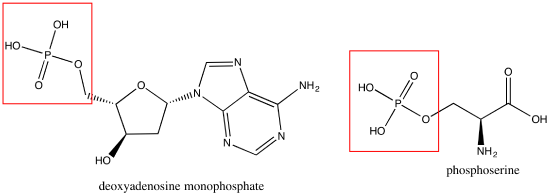
- A nucleotide on the left and phosphoserine on the right. Each has a phosphate group circled in red. Attribution: Created by Marc T. Facciotti (Ain work)
Water
Water is a unique substance whose special properties are intimately tied to the processes of life. Life originally evolved in a watery environment, and most of an organism'southward cellular chemical science and metabolism occur inside the water-solvated contents of the cell. Water solvates or "wets" the cell and the molecules in it, plays a fundamental office as reactant or product in innumerable number of biochemical reactions, and mediates the interactions between molecules in and out of the cell. Many of water's of import properties derive from the molecule'due south polar nature induced past the polar covalent bonds between hydrogen and oxygen, combined with the fact that these bonds are at an angle, resulting in a net dipole from the more O-rich pole to the more H rich pole of the molecule. In dissimilarity, in CO2 the bonds betwixt O and C are polar, but there is no net dipole (asymmetry of charge) from one end of the molecule to the other, considering the bonds extend at and 180˚ bending from each other (O=C=O). Thus CO2 is not a polar molecule, fifty-fifty though it has polar bonds.
In Bis2a, the ubiquitous role of water in virtually all biological processes is easy to overlook by getting defenseless up in the details of specific processes, proteins, the roles of nucleic acids, and in your excitement for molecular machines (it'll happen). However water plays key roles in all of those processes and nosotros will need to continuously stay aware of the role that water is playing if nosotros are to develop a better functional understanding. Be on the lookout and also pay attending when your instructor points this out.
In a liquid country, private water molecules interact with one another through a network of dynamic hydrogen bonds that are constantly forming and breaking (H bonds are relatively weak bonds). H2o likewise interacts with other molecules that take charged functional groups and/or functional groups with hydrogen bond donors or acceptors. A substance with sufficient polar or charged graphic symbol may dissolve or be highly miscible in water is referred to every bit existence hydrophilic (hydro- = "h2o"; -philic = "loving"). By contrast, molecules with more non-polar graphic symbol such every bit oils and fats practise non interact well with water and separate from information technology rather than deliquesce in it, equally we run across in salad dressings containing oil and vinegar (an acidic water solution). These nonpolar compounds are called hydrophobic (hydro- = "water"; -phobic = "fearing"). We will consider the some of the energetic components of these types of reactions in other another affiliate.

In a liquid land water forms a dynamic network of hydrogen bonds betwixt individual molecules. Shown are one donor-acceptor pair. Attribution: Marc T. Facciotti (original work)
H2o's Solvent Backdrop
Since h2o is a polar molecule with slightly positive and slightly negative charges, ions and polar molecules tin can readily dissolve in it. Therefore, water is referred to as a solvent, a substance capable of dissolving other polar molecules and ionic compounds. The charges associated with these molecules will course hydrogen bonds with h2o, surrounding the particle with h2o molecules. This is referred to as a sphere of hydration, or a hydration trounce and serves to keep the particles separated or dispersed in the water.
When ionic compounds are added to water, the individual ions interact with the polar regions of the h2o molecules and the ionic bonds are likely disrupted in the process called dissociation. Dissociation occurs when atoms or groups of atoms interruption off from molecules and form ions. Consider tabular array common salt (NaCl, or sodium chloride). When dry, a cake of NaCl is held together past ionic bonds and information technology is difficult to dissociate. When NaCl crystals are added to water, nonetheless, the molecules of NaCl dissociate into Na+ and Cl– ions, and spheres of hydration form around the ions. The positively charged sodium ion is surrounded by the partially negative accuse of the water molecule's oxygen. The negatively charged chloride ion is surrounded by the partially positive charge of the hydrogen on the water molecule. One may imagine a model in which the ionic bonds in the crystal are "traded" for many smaller scale ionic bonds with the polar groups on water molecules.

When table salt (NaCl) is mixed in water, spheres of hydration are formed around the ions. This figure depicts a sodium ion (dark blue sphere) and a chloride ion (light blueish sphere) solvated in a "body of water" of water. Notation how the dipoles of the water molecules surrounding the ions are aligned such that complementary charges/partial charges are associating with one some other (i.e. the fractional positive charges on the h2o molecules align with the negative chloride ion whereas the fractional negative charges on the oxygen of h2o marshal with the positively charged sodium ion. Attribution: Ting Wang - UC Davis (original work modified by Marc T. Facciotti)
Note: Possible discussion
Consider the model of water dissolving a table salt crystal presented above. Describe in your own words how this model can be used to explicate what is happening at the molecular level when enough salt is added to a book of h2o that the salt no longer dissolves (the solution reaches saturation). Piece of work together to craft a common movie.
Source: https://bio.libretexts.org/Courses/University_of_California_Davis/BIS_2A:_Introductory_Biology_%28Britt%29/01:_Readings/1.09:_Functional_Groups
Posted by: simsyonson.blogspot.com
0 Response to "What Is The Basic Molecular Makeup Of A Hydroxyl Group"
Post a Comment